Twitter Updates

    follow me on Twitter
    Showing posts with label Campus. Show all posts
    Showing posts with label Campus. Show all posts

    Friday, May 2, 2008

    Jahangirnagar University: The Beauty of Summer [May 2008]

    01 May 2008

    As Jahangirnagar University (JU) is one of my favourite places for a quick getaway, I always look for excuses to pay a visit there; even if thats during the scorching heat of summer. During my last visit to JU on 15 February, I put Sakran, my wife's cousin, on Krishnachura alert! I told him to call me the moment he find the red flowers in full bloom. That being the case, Sakran all on a sudden called me on 27 April. I knew that I had a long weekend coming, starting on Labour Day. But I needed to be sure of my time; so, I waited until the 30th before I gave Sakran my full go-ahead. Told him to stay there. As usual, I looked for partners. But people were busy for the day, I had to stick to my own individual plan.

    Original plan was to jump into the bus before 10AM. But the heat seemed too rough; so decided to start during the afternoon, when the sun would become at least a little tired. I boarded the bus exactly at 4:00PM and reached JU by 4:45. Scorching summer heat didn't give me any respite during the whole journey. Saw a few Krishnachura in bloom right beside the main gate. Sakran told me to come to his hall. Once I reached there, I found Sakran in the middle of an inter-batch cricket match. So, we waited until the match was over (Sakran unfortunately lost) and he got freshened up a bit. I watched the Indian Premiere League match for the time being. Anyway, we were on our way to walk around the campus by 5:15. The sun became quite bearable by then. We took a northerly route from Sakran's hall (Al Beruni Extension Hall) and went past Transport and Munni Sarani. It wasn't long before we started to find some Krishnachura on fire. The road took us towards the Vice Chancellor's house and beyond. The last part of the road was particularly fascinating. Before the JU School and teachers' quarters, we could see the road decorated with beautiful colours. We took our time to take photos as well as enjoying the beauty of nature.

    Before long the sun set in front of us. A scorching summer day went down with the sun. But this is a place where one can really see the beauty of nature. Most would like to hide themselves from the sun. But sun is the reason summer gets such magnificent colours. Our country is blessed with six seasons. And before we go near the nature and feel it, we do not realise what makes this blessing so unique.

    I boarded a return bus to Dhaka in the evening. The weather was no pleasant even without the sun. But hey, what would I except during the summer? And we need summer if we want the nature to bloom. We have to accept what nature brings for us; because thats were the beauty lies. This is one beauty man cannot create; at least for now.

    Jahangirnagar University Summer..............01

    Jahangirnagar University Summer..............03

    Jahangirnagar University Summer..............05

    Jahangirnagar University Summer..............06

    Jahangirnagar University Summer..............31

    Jahangirnagar University Summer..............07

    Jahangirnagar University Summer..............28

    Jahangirnagar University Summer..............11

    Jahangirnagar University Summer..............33

    Jahangirnagar University Summer..............27

    Jahangirnagar University Summer..............09

    Jahangirnagar University Summer..............35

    Jahangirnagar University Summer..............16

    Jahangirnagar University Summer..............17

    Jahangirnagar University Summer..............20

    Jahangirnagar University Summer..............24

    Jahangirnagar University Summer..............25

    Jahangirnagar University Summer..............26

    Sunday, March 30, 2008

    Rajshahi University, Rajshahi, October 2007

    Rajshahi University is the second largest University in the country and the highest seat of learning in the northern region. The University has crossed 53 years of its foundation opening its door for the students with a solemn promise to spread quality higher education an research on July 6, 1953. Situated at the green square of Motihar, the main campus of the varsity is very close to the river Padma and three miles east from the Rajshahi City. (Rajshahi University Official Website: www.ru.ac.bd/)

    The second largest university of Bangladesh, located 5 km north of the Rajshahi city. The recommendation for establishment of the university was made by the Sadler Commission formed by the Calcutta University in 1917 to conduct a feasibility study for a university for the students of the northern and southern regions of Bengal. The report of the Commission was shelved for long and only in 1953, the government of East Pakistan adopted the Rajshahi University Act 1953, which was published through a gazette notification on 16 June 1953. The Governor of East Bengal was the chancellor and Dr. Itrat Hossain Juberi, the Principal of Rajshahi college was appointed the first vice-chancellor of the university. He and a patron of learning Mr. Madar Baksh worked together to prepare a plan for the university. All intermediate and degree colleges and also the colleges of vocational and technical education of Rajshahi and Khulna divisions were affiliated to the newly established university. (www.banglapedia.org)

    The university is now governed by the Rajshahi University Act 1973. According to the act, the President of Bangladesh is its chancellor and the activities of the university are regulated by the senate, syndicate, academic council, finance committee and other statutory bodies. The vice-chancellor is the executive head and he is assisted by pro vice-chancellor, treasurer, registrar, controller of examinations, and a set of other officers. (www.banglapedia.org)

    The present campus of the university is at Matihar on 298.2 hectares of land acquired for the purpose. A master plan for the campus was designed by a foreign architect John A Zomanec and the construction of new buildings and structures started in 1958. The construction of the first phase to accommodate all offices and academic units was completed in 1964. At present, the university has two administrative buildings, a senate house, 8 academic buildings, 15 residential halls for students (4 for girls), residential houses for teachers and other staff (including separate houses for the vice chancellor and pro vice-chancellor), the central library building, central mosque, central auditorium, students' union building, medical centre, press, guest house and a cafeteria. Some institutes, special departments and facilities of the university are located within the campus and in the town and they include the Institute for Bangladesh Studies, the Department of Fine Arts, the University School and College, a rail station, the Barendra Museum and Barakuthi Building. A sculpture of the war of liberation, the Sabash Bangladesh and a Shaheed Minar has been erected at the campus. (www.banglapedia.org)

    At the beginning (1954), the university had only 156 students (6 girls) and in 2001, the number of students stood at about 20,000. The university now has 804 teachers, 472 officers, and about 1,600 support staff. Degrees offered by the university include bachelors (honours) and Masters in different disciplines as well as M Phil, Ph D, diplomas and Certificates. The departments and institutes of the university have so far (2000) produced 168 M Phils and 289 Ph Ds. The physical education department of the university has 27 instructors, a 25,000-seat stadium, 2 gymnasiums, 1 swimming pool, 4 football grounds, 1 hockey ground, 4 tennis courts, 2 basketball courts and a squash court. (www.banglapedia.org)

    Rajshahi University has a great role in all major historical movements of the country. The Pakistan army during the mass movement in 1969 killed Dr. Mohammad Shamsuzzoha, a Chemistry professor and the proctor of the university. During the War of Liberation they killed three other teachers: Habibur Rahman of Mathematics, Mir Abdul Quaiyum of Psychology and Sukhranjan Samaddar of Linguistics, 15 non-teacher employees and 9 students of the university. The name of the university is associated with many famous researchers and academicians who worked here in different capacities. Some of such people are Dr. Muhammad Shahidullah, Dr. Muhammad Enamul haq, Dr. AR Mallick and Dr. Abdul Karim. The university offered honourary D Lit to the French philosopher Andre Malraux in 1973. (www.banglapedia.org)


    Road under the canopy.............


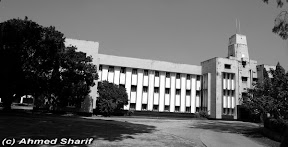
    Administrative Building


    Auditorium


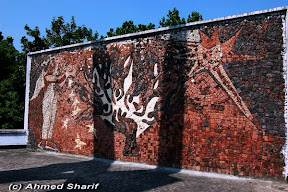
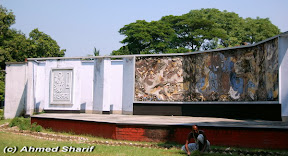
    Liberation War Memorial


    Mosque


    Subarna Jayanti Tower (Golden Jubilee Tower)


    Shabash Bangladesh

    Saturday, March 15, 2008

    Mymensingh Agricultural University, September 2005

    The Tranquil Brahmaputra
    The Visit to Mymensingh, 17 September 2005

    It was an instant decision. Saadi and I were thinking about a suitable place to visit while we were at Andalib’s on Friday night. We were looking for a place where we could go and come back within one day. A 2-hour journey would be nicely within acceptable limit. Saadi was right on his toes. But Andalib was citing his work. Shameem had office on Saturday. So, we were the only two travelling. Mymensingh Agricultural University seemed a good place to visit. It was final then. Two of us, off to Mymensingh the first thing tomorrow.

    We set our starting time at 9:00 AM from Mohakhali Bus Station. I knew Saadi; so, I called him before going out. As a matter of rule, I reached Mohakhali before him. We boarded a Rashik Transport bus at around 9:50 AM. These CNG buses look good and their seats are comfortable. It took more than half an hour for us to cross Tongi bridge. Once we reached the highway, it became clear that the bus didn’t have the acceleration for inter-city travelling. And it wasn’t too long either for us to find that the bus driver was literally playing with the lives of the passengers. We sat right behind the driver; so, I was virtually freaking out. Either the bus driver was terrible or the bus had terrible handling or both. Hell, this Chinese CNG vehicle accelerates very slowly; I don’t know what would’ve happened if the bus was as quick as any other long distance bus. Rashik was trying hard to justify their travelling cost: Taka 90 per person. They stopped at some place and brought in some soft drinks.

    The bus finally dropped us near Mymensingh town, from where we were supposed to get rickshaws for Agricultural University at a lower cost. We were within the compounds of the University in no time. Nice compound it looked, neat and clean and well planned. We went straight to the canteen, which just jumped on us. It was lunchtime and we were damn hungry. None of us had breakfast. We freshened up and had a nice lunch for us two within Taka 38. But the canteen didn’t have any soft drinks. They said that its available just outside the campus at Jabbar’s Moor, 10 minutes’ rickshaw journey. The scorching sun prevented us from searching for a cold bottle. We went out of the canteen through the back door and found a nice garden. Took some photographs of a nice building. And there was a nice mosque. Saadi had a religious idea and I didn’t have any objection to it.


    Once I entered the mosque, I was startled. It was a very nice feeling. The big single dome looked fantastic from the inside. There was some sort of fabric covering the whole base of the dome, through which the fans were hanging. But make no mistake this single dome and the nice spacious interior was really eye-catching. I had the instant idea of taking a snap. I waited until the end of Johr prayers to get permission from someone to take the snap. Unfortunately the only person I could talk to didn’t appreciate the idea of taking a photograph. Nevertheless, the calm weather inside the mosque left us sitting and lying on the cool mosaic floor and Saadi used his newly-bought Siemens camera mobile to take some snaps. None took notice of that.


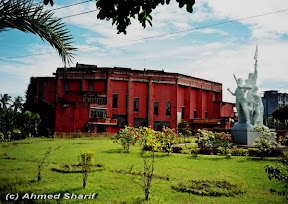
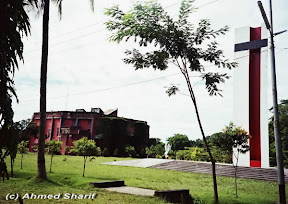
    We set off at around 2:15 PM to see the campus. Took a rickshaw and told the guy to take us on a sight-seeing tour. Went past all the student halls; took photographs and praised the planned campus. We stopped right before the Shilpacharya Jainul Abedin Auditorium. The nice building and the Liberation War sculpture in front had some worth taking photographs. There were a couple more monuments right behind the Auditorium. I took some photographs of this whole area.


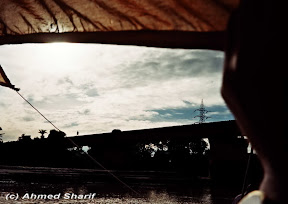
    We were off again and found some fruits that reminded us of our childhood memories. We took two and had those until we reached the Brahmaputra. Paid the rickshaw puller Taka 40 and jumped into a boat. When we said that we would go up to the bridge, which was quite far, he took a small sail in his boat. It was around 3:15 PM when we started our boat journey through the tranquil Brahmaputra. The waters were very calm. The Kashphul on the banks looked like decorations on a peaceful blanket. Saadi held the big umbrella overhead. And fortunately I brought my bag. An umbrella has just become a part of my everyday travel now-a-days. With two umbrellas, we could sit at our leisure. The sun was really burning and the nice bottle of soft drinks that we bought from Jabbar’s Moor provided us with a nice relief. We proceeded slowly along the banks. Watching the fishermen with their little fishhooks, we became curious. Saadi shouted at some fishermen asking about their success. The boatman shared some of his experiences with us. Fishes are no longer found in plenty that was used to be the case some years back. He hasn’t seen a lot of floodwater except in 1988 and last year. The villages on these banks were spared during the ’98 deluge.


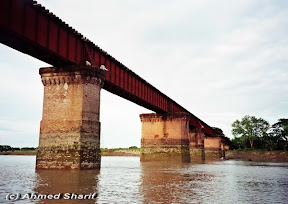
    We took some photographs of the river, the banks, Kashban and the clouds before we reached the railroad bridge. The old bridge didn’t seen a single train for more than 2 hours that we took during our tour. Not a busy railroad I guess. We could hear a lot of sound of trains honking, but they were all heading for Dhaka from the right bank, never crossing the bridge. This low traffic allowed some people to walk the bridge at a pretty leisurely pace. Some were sitting on the bridge pillars and fishing, a minimum of 40-50 ft up there. We didn’t feel the urge to go up to Shambhuganj Road Bridge. It was simply too far. So, we had to limit our interest in the old bridge. Took a few photographs and wondered at the red-bricked bridge.


    The boatman said that he could take us to the left bank where we would find tea with real cow milk. Frankly speaking, the day was just too hot for a hot cup of tea. We were sweating. We found a lot of other boats roaming in the river. The boatman said that this was a usual sight everyday. Most of these were students of the University. They were all in couples. Some were spending their intimate times behind a strategically placed umbrella. Some went even farther—right behind the forbidden Kashban.


    When we finally finished our cruise at 5:30 PM, it was already more than 2-hours’ journey. We gave the boatman Taka 120 for which he was not at all happy. But we decided to walk off. I wasn’t happy leaving the guy unhappy. A few more bucks could’ve made him happy. We took another rickshaw to the Maskanda bus stand. It was time for Magrib when we reached the bus stand. There was a mosque nearby and there was no reason for us to skip the prayers. We took some food from a restaurant nearby and went straight to the bus stand.

    This time it was a Hino bus and we could count on fast getaway. The bus was fast, but it did stop at many places to pick and drop people. We started at around 7:00 PM and couldn’t reach Banani before 9:30 PM. But at Taka 60 per head, we couldn’t ask for a lot more. It was a sleepy, but comfortable journey.

    Sunday, February 17, 2008

    Avifauna of Jahangirnagar University, February 2008

    15 February 2008

    Jahangirnagar University (JU) has always been one of my favourite places for recreation and recuperation. Can’t remember exactly how many times I’ve visited the campus. But its only been a couple of years that I’m carrying a camera with me to record some of the memories there. Had been lucky with friends studying over there, especially Saadi, one of my old buddies. His stay over there gave me the excuse to escape from the busy life of the Capital City. Even after he left the University, he couldn’t resist the temptation to give regular visits over there. And I always looked for the opportunity, though I went there only irregularly, compared to Saadi, of course.


    Anyway, this visit to JU campus was a little different as I had a specific objective to follow, shooting birds. On Thursday afternoon, as soon as my previously scheduled visit to Tangail was cancelled, I started to look for partners to accompany me to JU. Unfortunately Saadi was unavailable this time; but I found a new partner in Riad, my wife’s brother. Also acquired the privilege of having a host at the spot; Sakran, my wife’s cousin. My wife had been my travel partner on so many occasions, but she missed this one due to her Masters exam.

    Being less than an hour’s journey, JU never put any real pressure on me as far as hassle of travel is concerned. So, without worrying anymore, I woke up in the morning ready to travel. The first news came from Riad, as he fell ill and I was now on my own. I left home by around 9:15AM and took the bus from Asad Gate. The bus left me at the JU gate by around 10:00AM. JU campus is big and has a real flvour of nature to it. Its green surroundings, lotus-filled lakes, quiet paddy fields and chirping of birds take you to a rural setting, which we don’t get within this concrete jungle where we live. There are rickshaws to take you around, but I decided to rely on my feet, as I wanted to feel the nice environment of the campus more than anything else.

    Did I forget to mention that there was a Pakhi Mela (Bird Fair) going on at JU? Oh no!! It was a Friday, a holiday. And many people had the time off to take their families for some badly needed recreation. The JU Zoology Department took this opportunity to introduce people the beauties the campus contains, especially during the winter months. Every winter thousands of birds migrate to the campus and make this place full of life. A lot of people do visit the campus during winter. JU Zoology Department calls these times Pakhi Utsob (Bird Festival) to promote the phenomenon. But this time BRAC Bank came up with the sponsoring and the event got some real promotion. It just shows how corporates can make a difference. This reminds me of the sponsoring that HP did during our recent Photography Exhibition to aid victims of Cyclone Sidr. The event’s publicity brought a lot of people there and gave the city dwellers a chance to marvel at the brilliance of nature. This was especially nice for children, who are passing their time carrying heavy bags full of books. These bookworms are unfortunate enough to learn about these birds only on books. But this event brought the opportunity to at least some children to actually see and enjoy what they had been seeing only on pages.

    migratory ducks01

    migratory ducks04

    migratory ducks06
    migratory ducks

    Cattle Egret01
    Cattle Egret

    I went straight to the lake that housed most of the birds. There were programs going on at the Zoology Department, but I was more interested to see the birds in action. I reached the lake by around 10:15AM. It was a captivating sight and had to close my jaws to be able to bring out my photography equipment from my bag. I set up my equipment and closed on the birds. These birds, floating on water, made a joyful sound that kept the gathering crowd interested. Although most birds were resting on the lake bed, some were taking an aerial tour before coming back to the lake. But it was when most of the birds left water together with a brilliant flocking sound and deafening chirping noise that took the show. The audience was awed at this fantastic play of these magnificent creation of nature. It was as if they were all going by one single divine voice. What a sight this was!! I soon realised that my big lens was not capturing the real beauty of this event. I missed my wife dearly as she usually does the video during my visits. This is an event that carries more value on a video than still photos. I was entertained by these birds until my real venture got started. Sakran reached there by around 10:30AM. He usually stays at the hostel on the campus, but he just gave a visit to his parents’ at Uttara on Thursday, which is why he reached there after me.

    After a while with these birds, we decided to leave the lake for the opposite direction. As far as I know, JU hosts around 31 species of migratory birds every year. Of these 31 species of migratory birds, 28 are local species that come from different parts of the country. Local migratory birds throng the campus from the beels and haors of Sylhet, Nijhum Dwip and Chittagong hill tracts. Usually, about three species of birds reach the campus from Siberia and the Himalayas. A number of species use Bangladesh as a stopover to go on to another country. But what most people don’t know is that 128 species of resident birds live at the lakes and bushes around the lakes of JU, which had proved to be a safe sanctuary for the birds. During my previous visits there, I had the opportunity to some of them. Now I was prepared to find them, as many as we could.

    Red-vented_Bulbul04
    Bubuli (Red-vented Bulbul)

    Jungle Babbler02
    Sat Bhaila (Jungle Babbler)

    Black-hooded Oriole03
    Holde Pakhi (Black-hooded Oriole)

    Golden-backed Woodpecker06
    Black-rumped Flameback Woodpecker (Bangla Kaththokra), Male

    We headed for the wooded areas behind the Botanical Garden. The chirping reminded us that we were in the right place. Before we could realise, we found at least 5-6 species that are not commonly seen around populated areas. We noticed Bulbuli (Red Vented Bulbul), Fingey (Black Drongo), Sat Bhaila (Jungle Babbler), Holdi Pakhi (Black-hooded Oriole), Kaththokra (Black-rumped Flameback Woodpecker), Tuntuni (Common Tailorbird) and another two birds that we couldn’t identify. Apart from these birds, Bhat Shalik (Common Myna) and Gobrey Shalik (Pied Starling) were also there in abundance. The Woodpecker was a particular delight to watch as he flew from one tree to another and then jumped along the vertical plane of the tree trunks to show his acrobatic abilities. The Oriole and the Bulbul were also keen on showing their acrobatic skills. Sakran gave me a great help finding the birds. Soon enough Sakran proposed that we could go to another place where the woods are thicker. And off we go. We took a rickshaw and reached a place behind student halls. There were some young plantations that were quite thick, but prospect of finding birds over there seemed pretty low. We looked for opportunities to go to other wooded areas nearby where there may be more opportunities to find birds.

    Long-tailed Shrike02
    Kalomatha Koshai Pakhi (Long-tailed Shrike)

    Spotted Dove01
    Tila Ghughu (Spotted Dove)

    Indian Pond Heron&Yellow-wattled Lapwing02
    Indian Pond Heron & Yellow-wattled Lapwing

    Cattle Egret&Yellow-wattled Lapwing01
    Cattle Egret & Yellow-wattled Lapwing

    Red-wattled Lapwing01
    Lal Lotika Titi (Red-wattled Lapwing)

    Indian Pond Heron02
    Indian Pond Heron

    We soon figured out that it was 1:20PM and we had an empty stomach. So, rather than looking for the other wooded areas, we sat for lunch. We took our time to rest and then started yet again for the newer places. It was around 2:15PM. On our way we found a smallish wooded area that was looked pretty much barren. I noticed a small bird jumping from tree to tree over there and decided to capture it in the camera. What a pain this was! This was one agile bird and he simply touched the trees on the outskirts. He was never there on a single tree for more than one and a half moments. I took some snaps, but yet to identify the bird. As soon as we left that barren wood, we found a Kalomatha Koshai Pakhi (Long-tailed Shrike). He was jumping between small trees, quite close to us. I took the opportunity to follow him, as he was not as irritating as the earlier bird we tried to capture. He soon caught an insect and carefully displayed it in front of the camera before really dealing with it. Once we thought we had some good enough shots, we moved once again. This time we noticed a quiet lake in front of us and decided to head for it. We had a notion that as this looked like an isolated place, there may be bigger birds around here. We soon found a nice couple of Tila Ghughu (Spotted Doves) on a barren tree. They were nice enough to pose in front the camera even though we were quite close. The lake shore revealed, along with a lot of Pied Starling, a bright white Bok (Cattle Egret) roaming around. The Egret flew to the opposite bank, so I pointed my camera towards him. I was surprised to see that he was not alone on the other bank. He had a couple of Holud Lotika Titi (Yellow-wattled Lapwing), a Lal Lotika Titi (Red-wattled Lapwing) and an Indian Pond Heron with him. These aquatic birds were basking in the sun together moving ever so slowing. But occasionally they were making that graceful flight.

    Pied Kighfisher02
    Pied Kighfisher

    Magpie Robin01
    Magpie Robin

    Black Drongo01
    Fingae (Black Drongo)

    All on a sudden we were amazed by the superb entrance of a Machhranga (Pied Kingfisher). He didn’t land. He hovered over the water and looked for prey. After a short while of hovering in different places, he flew away and never came back. We again concentrated at the birds on the other side. We wanted to get a closer look at those birds, so we decided to go to the other bank of the lake. Before we moved on from this bank, we thought we should finish off our business on this bank. There was a small cottage nearby with several trees closely knitted. We decided to go in. There were quite a few birds resting there at least for a while—Bulbuli (Red Vented Bulbul), Fingae (Black Drongo), Sat Bhaila (Jungle Babbler), Gobrey Shalik (Pied Starling), Chorui (House Sparrow), Doel (Magpie Robin), Kalomatha Koshai Pakhi (Lang-tailed Shrike) and another bird, quite close to Magpie Robin, but don’t know for sure what it was.

    After finishing our business over here, we reached the other bank of the lake. It was already around 3:30PM. With winter light conditions, we had some one-and-a-half hour’s shooting time left with us. The other bank brought us very close to the Heron and the Lapwing. They few closer to us and gave us the opportunity to shoot them. They also made some noises while flying, giving us some idea about their voice. But there were more birds here. A brilliantly coloured Chhoto Machhranga (Common Kingfisher) flew around us, but eluded our camera. The same thing happened with Tuntuni (Common Tailorbird). There were quite a few Sat Bhaila (Jungle Babbler) that made a lot of noise together. Some Fingae (Black Drongo) were fighting in the air just like dogfight.

    migratory ducks02
    migratory ducks

    While around 4:00PM we decided to move to the same lake area where we started. We wanted to end the day with what we started with. Half and hour’s shooting before the light faded out. That was it. The chirping brought us here and they bade us goodbye in that same vociferous way.


    Left the campus with a lot of joyous memories and unfulfilled desire. I would surely want to come back here as there are many other birds that have not yet showed themselves to us.