Twitter Updates

    follow me on Twitter
    Showing posts with label design. Show all posts
    Showing posts with label design. Show all posts

    Saturday, May 30, 2009

    The Legend of Peari Das, Dhaka, May 2009

    Last Cry of a Legend
    29 May 2009
    33, Paridas Road, Dhaka, Bangladesh

    When my school friend Riel called me and proposed a photowalk, I couldn’t resist. It seemed too good an offer. Riel had access to this building through one of his friends, which gave us such a unique opportunity. All credit goes to Riel for arranging such a wonderful venture.

    The building located at 33 Paridas Road in the old parts of Dhaka was over a century old. According to the dwellers, who happen to be relatives of the current owners of the house, the building was around 170 years old. A building of this age isn’t that common in a tropical area like Bangladesh, where stones are not available for building construction. The building was constructed by an individual named Peari Das, who happened to be an important government official working at the municipality. He constructed a narrow road up to his house, and according to the then municipality rules, the short road was named after the constructor. There are many other roads in Old Dhaka with similar history. People who constructed buildings like these were wealthy people, holding important places in the society. Peari Das was no exception. The residents couldn’t mention the exact dates of construction. The building also doesn’t have an inscription.

    How did this building become so important to us? When Riel told me that the building was about to be demolished within a short time, I could realize the importance of it. We had to listed to the last cries of this legend. We organized the photowalk using “Through the Lens: Bangladesh” (TTL) group of Flickr. Shawon Da came from Sylhet along with a friend of his. Fakrul Bhai didn’t have to come from Sylhet, as he was already in Dhaka. Our TTL buddy Rezwan joined in, so did Saadi, a childhood friend of mine. Thanks goes to all of them to make this venture a successful one.

    We rendezvoused at Gulistan Circle by around 6:30AM and took rickshaw from there to reach Paridas Road. By around 7:05AM, we were there outside the building and we didn’t waste any time there watching. We straightaway unleashed our cameras and began to shoot. Riel had arranged permission beforehand and had some tough time convincing the owners that this venture was not going to harm them in any way. Anyway, we were really lucky to get the go-ahead from the owners. The owners don’t live there.

    From Legend of Peari Das, Dhaka, May 2009

    Its not a child's play anymore..........


    From Legend of Peari Das, Dhaka, May 2009

    The fate is locked..........


    From Legend of Peari Das, Dhaka, May 2009

    The western face...........


    From Legend of Peari Das, Dhaka, May 2009

    Windows.........


    From Legend of Peari Das, Dhaka, May 2009

    Old, but stylish.......


    The building was a west-faced one. The morning sun was behind the building. The front face was thus a bit gloomy. The front of the building showed off the grand pillars that resembled the days of the Zamindars. The two stories visible at the front had big balconies decorated with pillars. There were some trees surrounding the house, making it very difficult for us to get a clear shot of the whole building.


    From Legend of Peari Das, Dhaka, May 2009

    Morning shines..........01


    From Legend of Peari Das, Dhaka, May 2009

    Morning shines..........02


    From Legend of Peari Das, Dhaka, May 2009

    Morning shines..........03


    We spent some time shooting at the front, and then moved to the middle of the building after getting permission from the dwellers. The house had a wonderful courtyard in the middle. Morning light was peeping in to hit the western part of the courtyard. The western part was three stories high. That’s the part of the building where Peari Das lived hundred years ago. Some other members of his family lived in the eastern part. There were two kitchens for two types of food habits. One was for the vegetarians and the other one for non-vegetarians. This was related to Hindu culture of those days.

    From Legend of Peari Das, Dhaka, May 2009

    Top view.........


    From Legend of Peari Das, Dhaka, May 2009

    Morning shines..........04


    From Legend of Peari Das, Dhaka, May 2009

    In.........


    From Legend of Peari Das, Dhaka, May 2009

    Out.........


    We moved to the first floor quickly. This part was not in use for years. We had to maintain caution while moving around the floor. The first floor wasn’t as big as the ground floor. There were some open balconies there along with some rooms. We didn’t go into each room, but would’ve well appreciated that. We got some great view of the ground floor from above.


    From Legend of Peari Das, Dhaka, May 2009

    Closed.........


    From Legend of Peari Das, Dhaka, May 2009

    Of pillars and frames........


    From Legend of Peari Das, Dhaka, May 2009

    Of pillars and designs.......


    From Legend of Peari Das, Dhaka, May 2009

    Point of contact.........


    From Legend of Peari Das, Dhaka, May 2009

    Metal designs........01


    From Legend of Peari Das, Dhaka, May 2009

    Stairs and corridors...........


    From Legend of Peari Das, Dhaka, May 2009

    Metal designs........02


    From Legend of Peari Das, Dhaka, May 2009

    Metal designs........03


    From Legend of Peari Das, Dhaka, May 2009

    Metal designs........04


    From Legend of Peari Das, Dhaka, May 2009

    Metal designs........05


    From Legend of Peari Das, Dhaka, May 2009

    Stairs.........


    Anyway, we moved around until we ended up on the western face of the house on the first floor. The grand pillars stood there like guardians. The floor wasn’t that strong in some parts of that big balcony, especially towards the stairs that led to the second floor. Riel repeatedly warned me not to spend time near those stairs. The stairs didn’t have any support below. The walls were also not giving full support. Some parts were being penetrated by overgrowth.


    From Legend of Peari Das, Dhaka, May 2009

    An untimely death..........


    From Legend of Peari Das, Dhaka, May 2009

    Spotlight on silence........


    From Legend of Peari Das, Dhaka, May 2009

    Memories.........01


    From Legend of Peari Das, Dhaka, May 2009

    Memories.........02


    From Legend of Peari Das, Dhaka, May 2009

    Light still comes in.......01


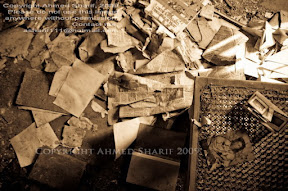
    We moved to the second floor and got stunned. This was the floor that contained most amount of mystery. The floor was in complete ruins. One room was full of destroyed books, newspapers, furniture, and what not. We even discovered some old family pictures in the ruins. The second room was virtually empty, which led us to the big roof. We could now get an idea where the building stood. There were high-rises going up everywhere. No wonder that the owners took the opportunity to hand over the building to developers. There was already a signboard outside the building, showing off the particulars of the developers. The building was counting days.


    From Legend of Peari Das, Dhaka, May 2009

    Light still comes in.......02


    From Legend of Peari Das, Dhaka, May 2009

    The last cry.......


    We could feel the heat in the open roof, even though it was hardly 8:15 in the morning. We spend some more time on the second floor, getting to feel the environ and also to find some more ideas. We came down to the ground floor, but couldn’t leave. Our host was just too generous to entertain us with a bit of breakfast. We finally left the building by around 9:00AM.

    We walked and tried to utilize the tour even more. We visited the legendary Beauty Boarding and was impressed by the old building beside it, which had an arch constructed under it, letting vehicles to travel under the building. The building was being used by the police. Anyway, we didn’t really spend much time over there. Shawon Da and Fakrul Bhai left the scene and they had some other engagement. The four of us hard breakfast at a local restaurant. After the meal, we found the weather a bit too harsh to continue the photowalk without any problem. It was hot and it was humid. We decided to call it a day. The adda was great, mind you.

    To summarize the tour, we had a great experience there among those old bricks. The designs, the textures, the feel of those damped-out walls would be in our mind for some time. It was actually hard to swallow that something as valuable was not in the protected list. We had to accept the inevitable with a heavy heart. I told Riel to keep an eye on the demolishing date. That might be a melancholy experience.

    Sunday, September 14, 2008

    Bridges of Chittagong, May 2008

    Bridges of Chittagong

    19 May 2008

    I took this as something of an assignment. I crossed the River Karnaphuli many times through the two bridges across. But never had a real opportunity to photograph these important structures. I had an opportunity to visit Chittagong on an official trip. Though engaged for the afternoon, the morning hours were free for me. I didn’t wait a bit. I plunged into the plan and went about it.

    From Bridges of Chittagong, Chittagong, Bangladesh

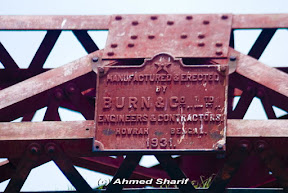
    The name is written in steel............

    From Bridges of Chittagong, Chittagong, Bangladesh

    This bridge is mostly made of steel.........

    From Bridges of Chittagong, Chittagong, Bangladesh

    Some solid construction..........

    From Bridges of Chittagong, Chittagong, Bangladesh

    Three wheelers crossing the bridge........

    From Bridges of Chittagong, Chittagong, Bangladesh

    The rail line through the middle of the bridge.........

    From Bridges of Chittagong, Chittagong, Bangladesh

    The central steel piece of the bridge........

    From Bridges of Chittagong, Chittagong, Bangladesh

    This is a single lane bridge............

    From Bridges of Chittagong, Chittagong, Bangladesh

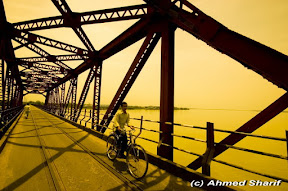
    A bicycle crosses the bridge........

    From Bridges of Chittagong, Chittagong, Bangladesh

    The metal structure..........

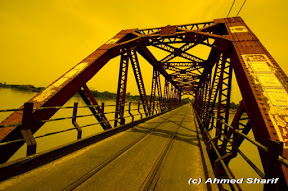
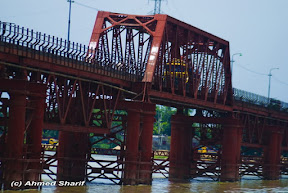
    Kalurghat Bridge was the farther one; so, my plan was to visit that one first. I took a CNG taxi and reached there by around 11:15AM. It’s a pretty old bridge; over 70 years old. Around 2,500 vehicles and 5 trains cross the bridge every single day. This is a legacy left by the British. This was the only bridge across the River Karnaphuli during the Liberation War of 1971. So, there are a few old memories of many people with this bridge. Its part of the history too. The bridge was built in 1931. It was repaired many times. The last repair was done in 2005 at a cost of Taka 100 million. The bridge was closed for ten months at that time.

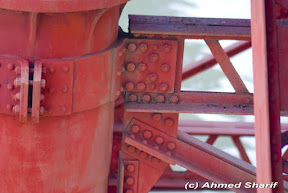
    The bridge is a steel structure resting on steel pillars; only a few concrete pillars stand at each end of the bridge. This is one narrow bridge. Originally this was built as a railway bridge. Locomotives still cross the bridge. Vehicles cross the bridge in one queue; one side at a time. Two vehicles cannot pass side by side. Pedestrians cross the bridge too. But it’s a risky to cross the bridge. There isn’t any separate walking lane and the pedestrians have to walk through the same narrow road used by vehicles. There are a few breathing spaces on the bridge, which helped me to avoid the vehicles. I just stood there when one side was open. I moved right after the end of one flow of vehicles. The road was clear until vehicles from the other side filled the walking space.

    From Bridges of Chittagong, Chittagong, Bangladesh

    The high tide makes the river flow upwards under the bridge......

    From Bridges of Chittagong, Chittagong, Bangladesh

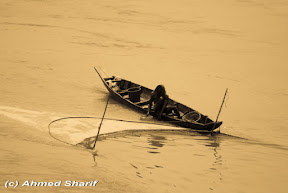
    Fishing in the Karnaphuli current........

    From Bridges of Chittagong, Chittagong, Bangladesh

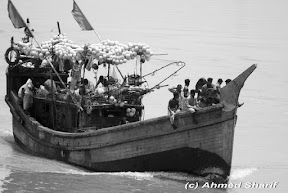
    Fishing trawler on the Karnaphuli........

    From Bridges of Chittagong, Chittagong, Bangladesh

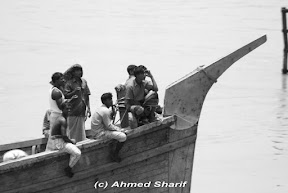
    Fishermen on the trawler.......

    From Bridges of Chittagong, Chittagong, Bangladesh

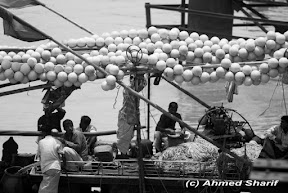
    The bubble boat!!!

    This river goes straight into the Bay of Bengal. The height of the river is controlled by tide in the sea; so is the current in the river. This current was visible under the bridge. Water was flowing from the sea side. That means it was a time of high tide. There were some fishing going on the north side of the bridge. The fishermen drew their nets and waited. The nets were under tension flowing to the north, following the strong current. Fishermen were waiting on some boats to maintain the nets. There was some traffic in the Karnaphuli. Most of this traffic was the result of fishing trawlers going towards the sea. The trawlers were full of fishing nets that had those white floaters attached. The floaters stood out under the shining sun and gave an interesting look to those boats.

    From Bridges of Chittagong, Chittagong, Bangladesh

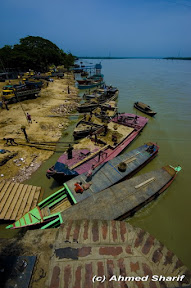
    The busy northern bank.........

    From Bridges of Chittagong, Chittagong, Bangladesh

    Toiling away under the sun.........

    From Bridges of Chittagong, Chittagong, Bangladesh

    Builders of the land........

    From Bridges of Chittagong, Chittagong, Bangladesh

    The central section of Kalurghat Bridge seen from the northern bank.......

    I spent some time photographing the bridge and its surroundings. By around 11:45AM I was again on the northern bank and decided to have a look at the northern end of the bridge. There were many boats parked by the bridge at this end. Quite a busy place. Construction materials, especially sand, was being dumped at this end from boats. Day labourers were toiling hard to unload the boats manually. These are the people that make all the structures possible; the unsung heroes of the land. The place gave me a great look of the whole bridge as well.

    From Bridges of Chittagong, Chittagong, Bangladesh

    The Shah Amanat Bridge..........

    From Bridges of Chittagong, Chittagong, Bangladesh

    The steel structure.........

    From Bridges of Chittagong, Chittagong, Bangladesh

    The signboard showing the specs of the Third Karnaphuli Bridge.......

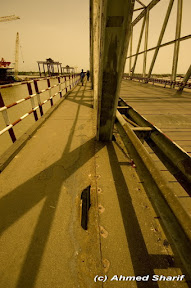
    By around 12:00 noon I moved out and proceeded towards the second bridge across the Karnaphuli, the Shah Amanat Bridge. It took around half and hour for me to reach there. I was lucky because it was a weekend and there was less traffic on the road. I reached Shah Amanat by around 12:35PM. This bridge is comparatively young, but in a comparatively poor state. It was opened for traffic in 19990. The bridge was damaged by an enormous cyclone on the night of 19th April 1991, when the waves and wind blew a massive floating crane 6.5km and crashed in on the middle spans. The crane drowned under a 400tonne section of the bridge. It took time to repair the bridge and make it operational once more. But the bridge wasn’t built as strongly as the Kalurghat Bridge. So, its current condition isn’t very much delightful. Because of its poor condition, there was a third bridge across the river under construction. This third one is almost beside the Shah Amanat Bridge. Big signboards display the specifications of the under construction bridge.

    From Bridges of Chittagong, Chittagong, Bangladesh

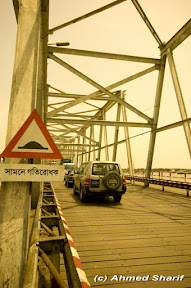
    Speed breakers galore........

    From Bridges of Chittagong, Chittagong, Bangladesh

    The hole in the floor!!

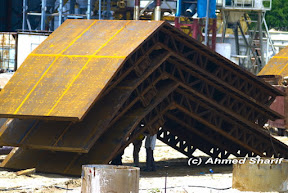
    The Shah Amanat Bridge relies on its wooden deck. But the deck developed cracks in many places within 10 years of construction. The bridge never retained its glory and now it shakes with the approach of each vehicle. The bridge was declared unfit for heavy vehicles in May 2000. But smaller vehicles could still cross. Big holes developed in the deck afterwards, which caused frequent accidents. It was then repaired on an emergency basis in 2006-07 at a cost of Taka 55 million. 7,000 wooden planks were imported from South Africa to replace the deck of the bridge. Vehicles still have to maintain a slow progress rate and to ensure that, speed breakers were set up at each and every few yards. Rickshaws and pedestrians cross the bridge by the single lane narrow path on each side of the bridge. This is much better than the Kalurghat Bridge, which doesn’t allow rickshaws to pass and doesn’t care about pedestrians. Rust ate into the structure and some holes formed in the metal floor sections of the bridge floor. I could see the river through those holes!

    From Bridges of Chittagong, Chittagong, Bangladesh

    Construction equipment for the third bridge.........

    From Bridges of Chittagong, Chittagong, Bangladesh

    The massive pillars..........

    From Bridges of Chittagong, Chittagong, Bangladesh

    And the massive cranes..........

    From Bridges of Chittagong, Chittagong, Bangladesh

    Work is going on.........

    From Bridges of Chittagong, Chittagong, Bangladesh

    Construction materials on the northern bank.......

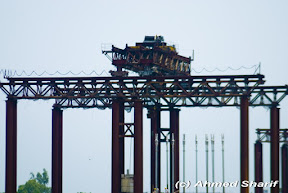
    The main attraction of this bridge seemed to be the other bridge! The Third Karnaphuli Bridge’s construction work attracted me more than anything else. This would be a 980m long bridge, which would cost an estimated Tk 5.9 billion. There were big cranes working on the pillars. The northern bank was full of construction materials and fabricated sections. A narrow causeway also made a way for the workers to reach the middle of the river. The bridge had some pillars under construction.

    From Bridges of Chittagong, Chittagong, Bangladesh

    Rickshaw vans and pedestrians crossing........

    From Bridges of Chittagong, Chittagong, Bangladesh

    A dangerous sport.........

    From Bridges of Chittagong, Chittagong, Bangladesh

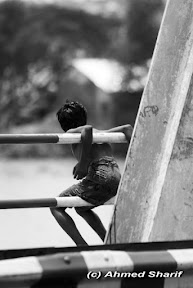
    Leaning over........

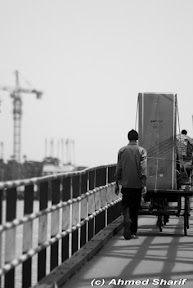
    Activity on the Shah Amanat Bridge was also nothing to write home about; just regular traffic. No rail lines here and no need to dodge motor vehicles. Although I had to keep an eye on the rickshaws and rickshaw vans coming my way. Some street children were playing on the other side of the bridge. They were basically hanging by the railings and playing a very very dangerous game!

    From Bridges of Chittagong, Chittagong, Bangladesh

    Under the norther end of the Shah Amanat Bridge.......

    From Bridges of Chittagong, Chittagong, Bangladesh

    It was a heated sun........

    From Bridges of Chittagong, Chittagong, Bangladesh

    The Shah Amanat Bridge........

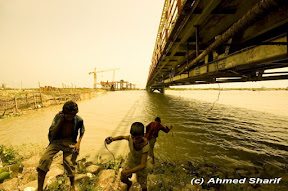
    I went to the northern end of the bridge once more and sought to take some photographs from that angle. Some children were playing under the bridge’s dry areas, whereas some adults were relaxing under the cool shadow of the bridge.

    It was around 12:00PM when I decided to break off. The tour was a good documentation of a place and time which is going through a lot of transition. This record would help to compare the landscape some time later. Chittagong is my favourite city. I would surely have my chances to visit here once more, unless God sees it otherwise.